

Knowledge Hub
Explore All Facts
Q1. Is All Plywood the Same?
Plywood may look similar on the surface, but its performance is determined by veneer species, veneer quality, core construction, adhesive bonding, thickness tolerance and manufacturing precision.
Indiana Birch plywood features full-size 8×4 and 10×4 birch veneers, constructed without sectional joints, for a more continuous core structure. Combined with precision cross-banding and controlled bonding, this construction delivers consistent panel integrity, exceptional screw holding capacities, dimensional stability and a uniform surface ideal for precision furniture, premium laminates and demanding interior applications.


Q2. Why Does the Quality of the Core Matter?
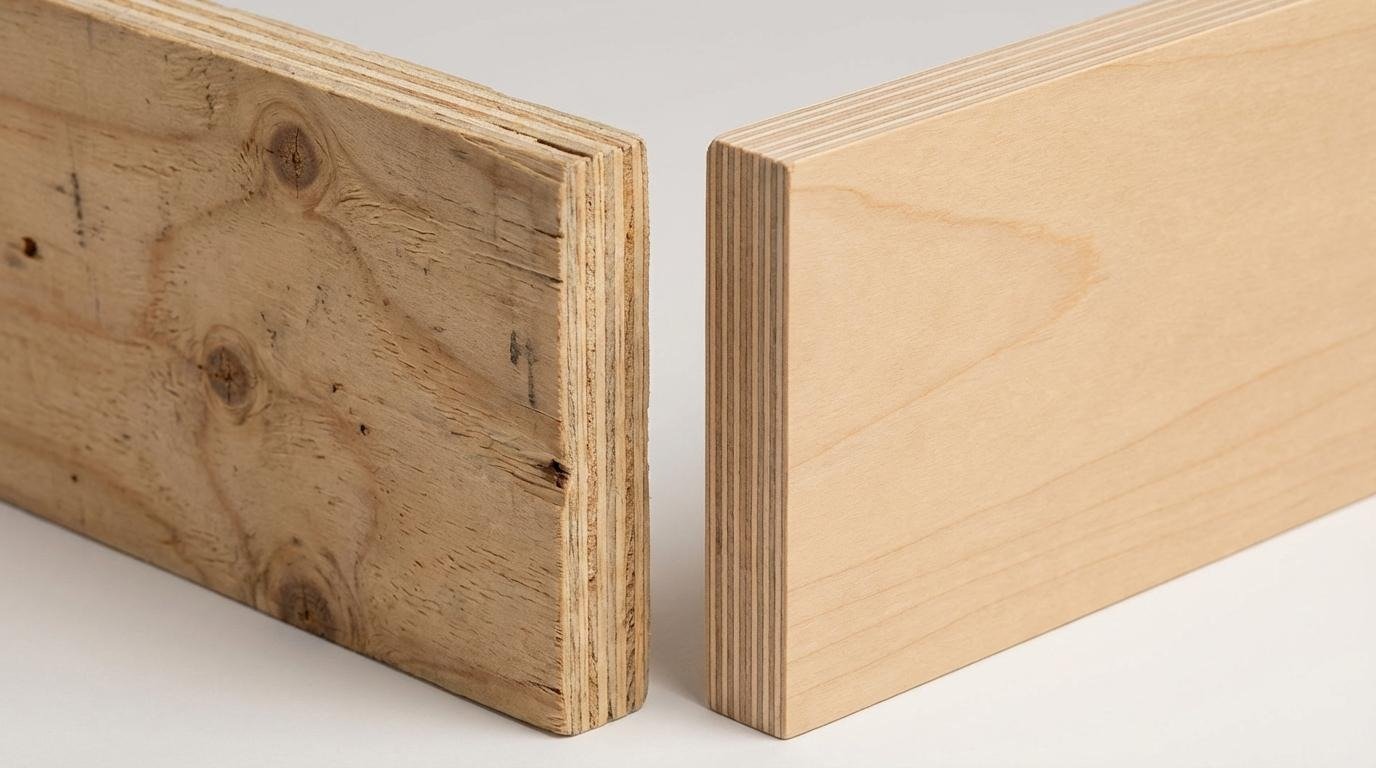
The difference lies beneath the surface. Conventional plywood may use a combination of wood species and smaller veneer sections, whereas Indiana Birch is engineered using full-size 8×4 and 10×4 birch veneers, without sectional joints in the core construction. This creates a more continuous, consistent core with fewer opportunities for gaps and weak spots.
Sourced from Russian birch, a hardwood that grows in climates where winter temperatures can plunge to −50°C, these veneers are prized for their fine grain, uniform texture and dense wood structure. Precision cross-banding and quality bonding further contribute to dimensional stability, dependable screw-holding performance and clean machining.
And the beauty doesn’t stop at the core. The natural birch grain offers a refined, understated aesthetic that can be showcased directly or finished with PU coatings. Its smooth, uniform surface also makes it suitable for decorative veneer pasting and premium laminate applications.
Q3. What Does Calibrated Plywood Actually Mean?
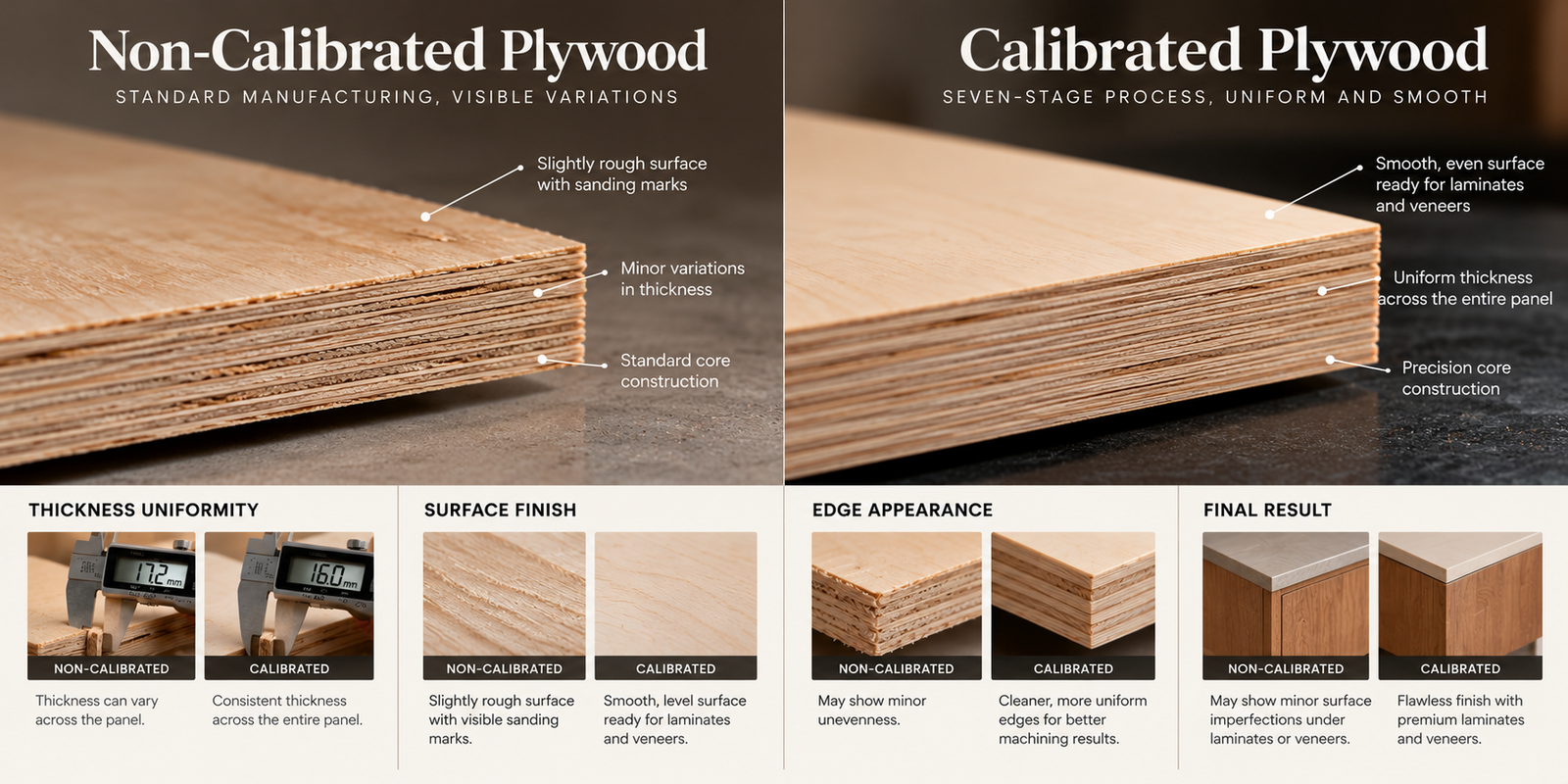
True calibration is about precision, not shortcuts. Our specialized seven-stage manufacturing process involves four stages of pressing and three stages of sanding and calibration to achieve exceptional thickness uniformity and a consistently even surface.
Multiple sanding stages demand additional processing time and reduce production throughput. Yet, we believe perfection cannot be rushed. Indiana Birch, with its dense, fine-grained structure, provides an excellent foundation for achieving the consistency and precision that premium applications demand.
Q4 Why is 1.5mm Face Veneer different and important?
The difference lies in the construction.
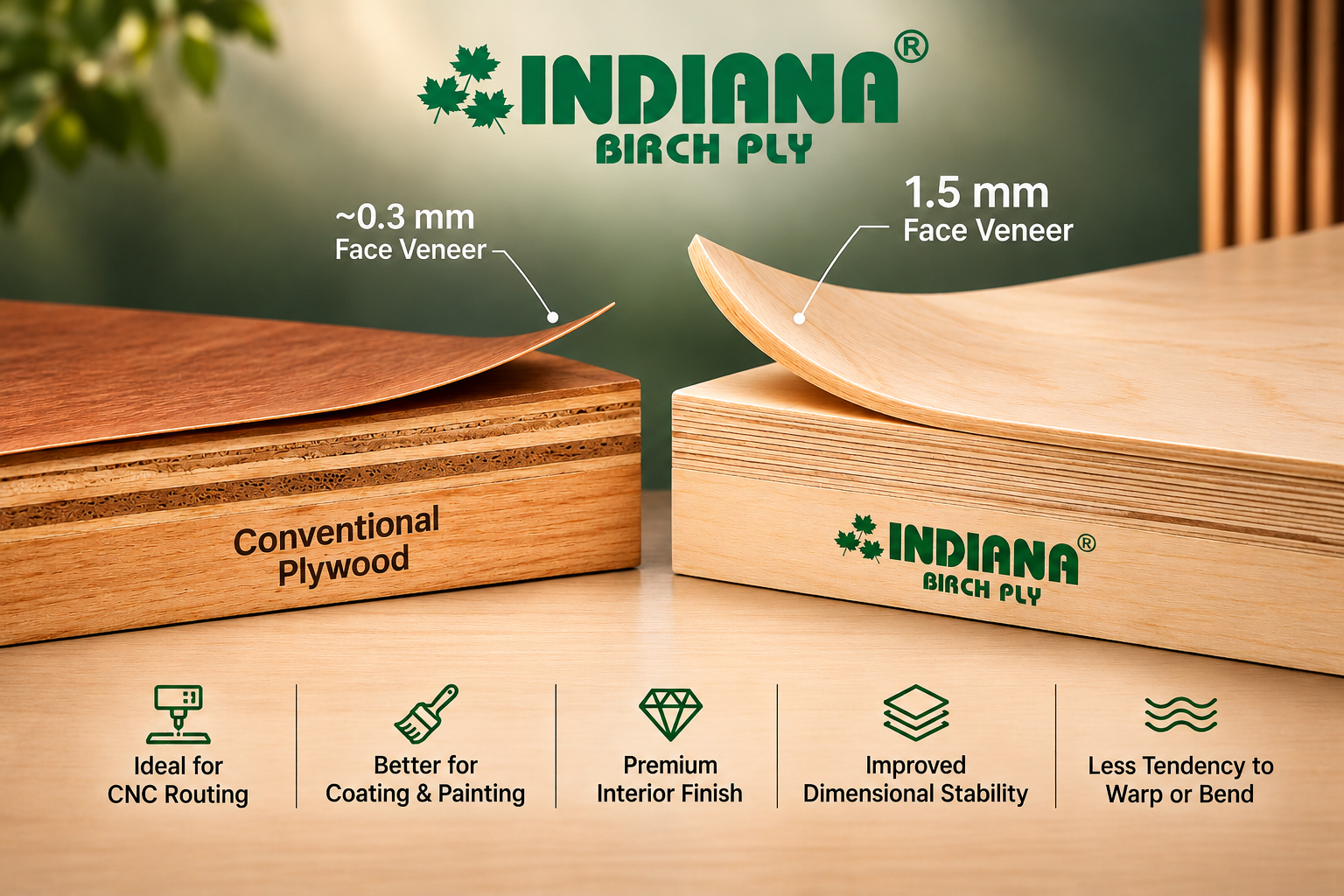
Conventional plywood typically uses a face veneer of approximately 0.3 mm, whereas Indiana Birch Plywood features a premium 1.5 mm face veneer—a substantially thicker surface layer designed to offer greater versatility and enhanced performance.
This thicker face veneer makes the plywood suitable for a wider range of applications, including CNC routing, coating, painting and premium interior work. It also contributes to improved panel stability and helps reduce the tendency to warp or bend when compared with conventional constructions, subject to the overall panel design and manufacturing conditions.
The result is a plywood panel that combines a premium surface with greater application flexibility and dependable performance.
Q5. What Should You Know About Formaldehyde Emissions, and Why Do They Matter?
Your home should be a place of comfort, not a source of hidden health concerns. Formaldehyde is a chemical classified as carcinogenic to humans, and prolonged exposure can pose threats to diseases like Cancer.
That’s why Indiana Birch Plywood is CARB Phase 2 Certified and TSCA Title VI Compliant—meeting stringent formaldehyde-emission requirements designed to help protect indoor air quality. Because what goes into your home matters just as much as how it looks.


Q6. Does the Plywood Edge Reveal Anything About Its Construction?
Absolutely. The exposed edge of Indiana Birch Plywood offers a visible insight into its multi-layered construction. The uniformity of the veneer layers, consistency of the core, bonding between plies and absence of visible core gaps can indicate the precision with which the panel has been engineered.
Q7. Why Do Screw-Holding Strength and Dimensional Stability Matter?
Screw-holding strength affects how reliably fasteners secure furniture joints, fittings and hardware. Dimensional stability helps a panel maintain its dimensions as environmental conditions change.
Birch trees thrive in some of the world’s harshest climatic conditions, and their naturally strong, dense wood makes them an exceptional choice for demanding applications. Indiana Birch Plywood combines full-core construction in 8×4 and 10×4 formats with a premium 1.5 mm face and back veneer, engineered for strength, stability and versatility. Its exceptional screw-holding capabilities and robust construction make it a premium choice for high-end furniture and interiors.